 Rocket Ads
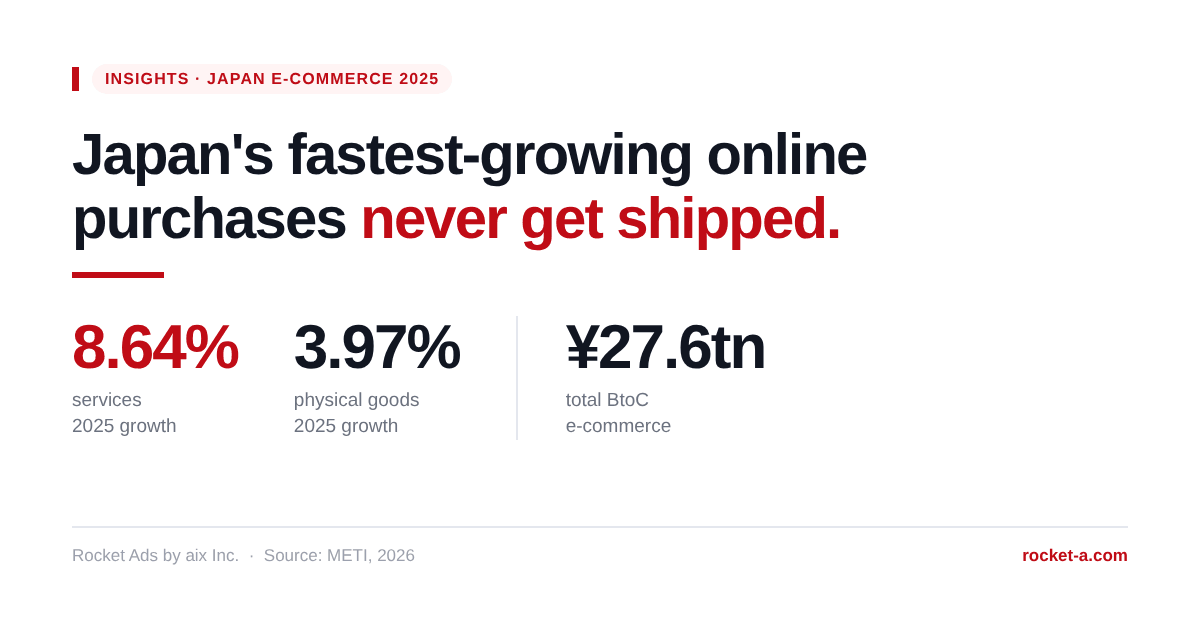
What is the fastest-growing kind of online purchase in Japan? The kind that never ships. According to the e-commerce market survey the Ministry of Economy, Trade and Industry (METI) published in October 2026, service transactions in Japan grew 8.64% in 2025 against 3.97% for physical goods, roughly 2.2 times faster. Travel bookings, event tickets, salon appointments: none of it arrives in a box.
The survey has run annually since 1998, now in its 28th edition, and splits consumer e-commerce into three categories: physical goods, services and digital content (METI, 2026).
Where did Japan’s online spending grow in 2025?
| Category | 2024 | 2025 | Growth |
|---|---|---|---|
| Physical goods | ¥15.22tn | ¥15.82tn | 3.97% |
| Services | ¥8.23tn | ¥8.94tn | 8.64% |
| Digital content | ¥2.68tn | ¥2.80tn | 4.52% |
METI (2026), domestic BtoC e-commerce in Japan, 2025.
Japan’s total BtoC e-commerce reached ¥27.6 trillion in 2025, up 5.5% (METI, 2026). Three things are worth pinning down before reading the ratio.
- Physical goods are still the larger pot. METI (2026) puts goods at ¥15.82 trillion and services at ¥8.94 trillion, about 1.8 times apart. Services have not overtaken goods.
- Service growth slowed from the previous year, from 9.43% to 8.64%, and the report describes the overall pace as having slowed (METI, 2026).
- Goods growth sped up in the same year, from 3.70% to 3.97% (METI, 2026).
The gap held at 2.2 times in a year when one side slowed and the other accelerated. That is what makes the number worth reading.
What sits inside the services category?
| Sub-category | 2025 | Growth |
|---|---|---|
| Travel | ¥3.76tn | 6.68% |
| Food service | ¥1.10tn | 13.34% |
| Finance | ¥1.09tn | 10.66% |
| Ticketing | ¥0.81tn | 15.13% |
| Other (medical, insurance, housing, education) | ¥0.81tn | 6.00% |
| Beauty | ¥0.80tn | 9.49% |
| Food delivery | ¥0.56tn | 3.43% |
METI (2026).
Travel alone accounts for 42% of the services category. In a year when the category as a whole slowed, METI (2026) singles out three lines that grew faster than they had the year before.
- Ticketing, from 6.05% to 15.13%
- Beauty services, from 6.54% to 9.49%
- Food delivery, from a 7.26% decline to 3.43% growth
The list has one thing in common. Not a single item on it arrives in a box. A flight seat, a hotel room, an event seat, a restaurant table, a salon slot. Every one of them is a date and a time.
Are games and subscriptions in this number?
They are not. Online games, e-books and music and video subscriptions sit in digital content rather than services (METI, 2026).
- Online games, ¥1.28 trillion, 1.65% growth, after a 0.58% decline the previous year
- Paid video subscriptions, ¥0.55 trillion, 13.66% growth
- Paid music subscriptions, ¥0.13 trillion, 8.65% growth
- E-publishing, ¥0.69 trillion, 2.18% growth
Online games are the slowest line among the sub-categories in the survey. So the fast-growing part of Japan’s online spending is not games. It is purchases that end in a booking.
What Rocket Ads reads into this
The figures above are estimates of transaction value, not measurements of app installs or campaign performance. What follows is not a survey finding. It is how Rocket Ads reads the shift when designing Japanese campaigns.
In a purchase that ends in a booking, payment is often not the last thing the user does. In a hotel app the user picks dates and holds a room; in a salon app they hold a time. The money may change hands on site, or later against a booking already made.
Performance campaigns still tend to set the completion event at first purchase, a convention borrowed from apps that sell physical goods. Applied to an app with no delivery, one of two things happens: too few users ever reach the condition, or the condition closes before the user has experienced the service at all.
Where can a booking-based app put the finish line?
CPE lets the advertiser choose the event that triggers payment, which means the finish line can sit where the app actually wants it. Three options come up most often.
- Booking completed. One confirmed date ends the campaign’s scope. The most direct option, and the shortest window to completion.
- First visit. Where booking and use are far apart, a booking alone does not tell you the user experienced anything. Check-in or attendance becomes the completion event, at the cost of a longer window.
- Sign-up and booking split into tiers. Pay once at registration and again at the first booking. This suits categories where the path to a first booking is long and users stall partway.
Which one fits depends on the category and on the gap between booking and use. Measure that gap first, then choose the completion event. The order matters more than the choice.
What to take from this
- Japan’s online service transactions grew 8.64% in 2025 against 3.97% for physical goods, about 2.2 times faster (METI, 2026).
- The gap held even though service growth slowed from 9.43% and goods growth rose from 3.70% in the same year.
- Physical goods remain about 1.8 times larger in absolute terms. Services have not overtaken them.
- Games and subscription content are not in the services figure. Online games grew 1.65%, the slowest line in the survey.
- Everything in the services category is a date and a time. Setting the finish line at payment puts it somewhere the user may never go.
If you are planning UA in Japan or want to talk through a current campaign structure, Rocket Ads is happy to go through it with you.